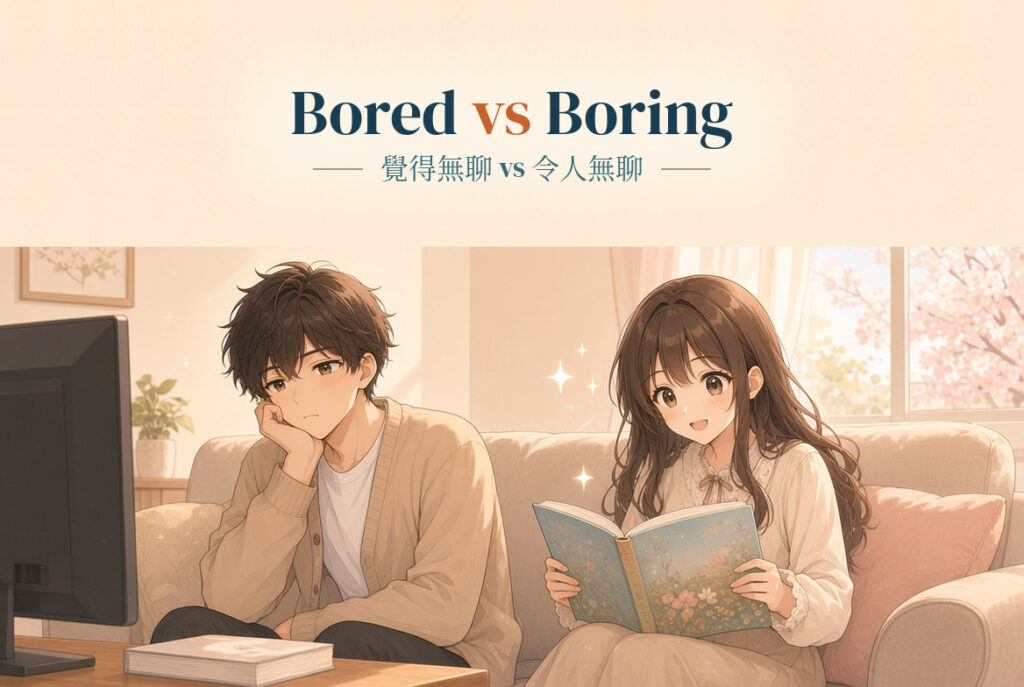
老師,我跟外國朋友說 “I’m so boring”,想表達「我好無聊」,結果他笑了出來。中文都是「無聊」,bored vs boring 到底差在哪呢?
正確答案:看是「人覺得無聊」,還是「事物讓人覺得無聊」。
定義說明:
1) bored = 感到無聊,描述「人的感受」
結構:人 + be/feel/get + bored(with/of + 事物)
2) boring = 令人無聊的,描述「讓人有這種感受的人事物」
結構:事物 + be + boring 或 a boring + 名詞
快速判斷:感受到情緒的人 → -ed;引起情緒的原因 → -ing。
同樣規則的常見字:
interested/interesting(感興趣的/有趣的)
excited/exciting(興奮的/令人興奮的)
tired/tiring(疲累的/累人的)
confused/confusing(困惑的/令人困惑的)
例句:
bored(人覺得無聊 → 感受)
I’m so bored. Let’s go for a walk.
(我好無聊,我們去散步吧。)
👉 說自己的心情,用 -ed。
Kushiko got bored during the long meeting.
(Kushiko 在冗長的會議中覺得很無聊。)
boring(讓人覺得無聊 → 原因)
The movie was so boring that Cushy fell asleep.
(那部電影太無聊了,Cushy 看到睡著。)
He talks about his car all the time. He’s so boring.
(他整天都在聊他的車,這個人真的很無趣。)
👉 boring 形容人時,意思是「這個人讓別人覺得無聊」。
其他 -ed/-ing 字
Cushy is interested in Japanese food.
(Cushy 對日本料理很有興趣。)
※ interested 後面常接 in。
The HBL final was really exciting.
(HBL 冠軍賽真的很精彩。)
常見錯誤:
❌ I’m so boring today.
✔ I’m so bored today.
❌ I’m interesting in music.
✔ I’m interested in music.
❌ The game was very excited.
✔ The game was very exciting.
中文的「無聊」可以同時指感受和原因,英文卻分成兩個字。中文與英文畢竟是兩種不同語言,不要直接套用中文邏輯來思考英文。
會話:
A: Why do you keep yawning? Are you bored?
(你怎麼一直打哈欠?你覺得無聊嗎?)
B: A little. This lecture is really boring.
(有一點。這場演講真的很無聊。)
A: Are you interested in the jazz festival in Taichung?
(你對台中的爵士音樂節有興趣嗎?)
B: Yes! It sounds exciting.
(有啊!聽起來很精彩。)
簡單來說:
人感受到情緒 → -ed(I’m bored.)
事物引起情緒 → -ing(The movie is boring.)
小口訣:人覺得用 -ed,讓人覺得用 -ing
下次想說「我好無聊」,記得說 I’m bored,別不小心變成「我是個無聊的人」囉!